THE INTELLIGENCE ENGINE / AI • DEVELOPERS • BUSINESS
Issue 001 — AI Is Leaving the Chat Window
Real answers from Kris Krüg, the mathematics question, four verified emerging AI projects, useful tools, business ideas and three original vintage house-ad spreads.
MONTHLY / THIRD FRIDAY EDITION · INDEPENDENT SOURCE-VERIFIED REPORTING
FIELD NOTE 001. AI is shifting from conversation to action. The advantage for entrepreneurs will not simply be having a smarter chatbot. It will be using models, data, interfaces and human oversight to deliver a dependable result.
THE LEAD: AI IS LEAVING THE CHAT WINDOW
OpenAI announced GPT-6 with Intelligent UI on October 7. The idea is that responses can include interactive interfaces appropriate to a task, not only prose. Imagine a customer comparing workshop equipment, adjusting requirements in a structured view and seeing unresolved specifications before making a decision. That is a different product experience from asking for a paragraph.
It does not eliminate the need to verify sources, respect permissions or make consequential choices deliberately. An attractive interface can still be wrong.
THE BIG QUESTION: CAN WORDS REALLY DO MATHS?
"My maths teacher would want to see the working." That's the question we sent to Kris Krüg for our first written interview. And Kris has now answered in his own words — read the first full written interview below.
In July 2025, an advanced Gemini Deep Think system produced natural-language proofs on the International Mathematical Olympiad problems and scored 35 out of 42, a gold-medal-standard result graded and certified by the event's coordinators. OpenAI separately reported a gold-standard score for an experimental reasoning model, graded by former medallists, but not as an official Olympiad entry. These were exceptional research systems, not evidence that every public chatbot beats a mathematician.
Then, on October 6, 2026, OpenAI publicly released a large collection of mathematical manuscripts generated by an internal frontier model. The independent Advisory Group on Mathematics and Artificial Intelligence welcomed wider examination while stressing that release is only the start of mathematical validation and human understanding, not proof that every reported result is settled.
So are words replacing equations? Not quite. Language models work with patterns of tokens that can represent ordinary language, symbols, formal notation and lines of argument. A proof written in ordinary sentences can still be rigorous mathematics, but the truth of its claims must be independently checked. Formal proof assistants such as Lean offer one way to check carefully specified steps; mathematicians still have to understand what was proved and why it matters.
STEP
WHAT HAPPENS
THE HUMAN QUESTION
01 / ASK
A problem is posed in words or notation.
What exactly are we trying to show?
02 / REASON
A researcher or model proposes a proof.
Does each step actually follow?
03 / VERIFY
Mathematicians and, where applicable, formal tools check it.
Are there gaps or hidden assumptions?
04 / UNDERSTAND
People explain, reproduce and build on the result.
What have we really learned?
OUR ORIGINAL EXPLAINER · The difference between generating a mathematical claim and establishing mathematical knowledge.
The interview has arrived: Kris Krüg returned the completed seven-question written interview on October 16, 2026. Below are attributed excerpts from his real replies, not a simulated Q&A.
CLASSROOM WORKSHOP: MAKE A SQUARE WITH WORDS
Here's a tiny exercise for readers who haven't touched an equation in years. Begin with one square tile. Add three more to make a 2-by-2 square. Add five to make a 3-by-3 square, then seven to make a 4-by-4. Why does adding successive odd numbers always make a new square?
Words: Each new L-shaped border adds one row and one column, counting the shared corner only once. Numbers: 1 = 1; 1 + 3 = 4; 1 + 3 + 5 = 9; 1 + 3 + 5 + 7 = 16. Equation: 1 + 3 + ... + (2n − 1) = n². Verification: Check how many tiles the next border adds before trusting the general rule.
Try this with an AI assistant: Ask for three independent explanations — plain language, a sketch, and a formal argument — then see whether each predicts what happens at the next size. Learning doesn't mean choosing between words and equations. It means connecting them.
THE SIGNAL: RELEASES TO WATCH
OpenAI Decisions API
OpenAI's October API changelog reports public beta availability of the Decisions API. It provides narrow scoring and classification workflows where an application may need a structured determination instead of a long response. The provider's speed claims should be treated as vendor-reported until independently measured.
Agents that operate software
OpenAI documents computer-use capabilities through the Agents API and hosted browser sessions. These enable tightly bounded website interactions. A useful production system also needs logged activity, explicit permissions, reliable recovery and human approval for sensitive steps such as sending messages or spending money.
Cheaper, faster models
OpenAI's changelog lists an Ultrafast processing option for GPT-6.1 Sol. Anthropic announced Claude Haiku 5.5 on October 7. Reuters reported Google's launch of Gemini 4 Argon for developers and businesses on October 13. Comparing such products demands more than benchmark scores: total cost per acceptable result, latency, support and integration matter.
Google offers frontier science tools to researchers
On October 14, Google DeepMind and Google Cloud announced a plan to give up to 200 European scientific researchers access to frontier tools, including AlphaFold 3, WeatherNext, AlphaGenome and AlphaEvolve, through the EU's RAISE initiative. It's a pledge of access, not a report of completed research. The interesting question: how much new science can people do when advanced tools become easier to reach? Read Google's announcement.
THE TOOL BENCH: TEST BEFORE YOU TRUST
Classification: Give a decisions model a labelled set of real inquiries and record its mistakes. Computer use: Test low-risk workflows in a sandbox with supervision before granting production access. Interactive UI: Watch whether customers understand the outcome faster, not merely whether the screen looks clever. Small models: Measure task completion cost, including human correction.
THE NEW NEW: FOUR IDEAS FROM THE WORKBENCH
1. Voice games built in an afternoon, not a billion-dollar lab. At Vancouver's October 7 Alebex voice-AI hackathon, community makers produced 11 prototypes in a short sprint. Charlene's playful Don't Die In Office asks players to navigate tricky conversations, while other teams tried appointment rehearsal, accessibility and hands-free cooking. These are prototypes, not clinically validated tools or retail products. See the organizer's project roundup.
2. A little computer, a whole team of AI helpers. Base Compute's newly announced open-source Superfluid server explores how several local AI jobs can share one machine without making a person wait behind batch work. The makers published their design and benchmarks; this publication has not independently measured them. Read the developer release.
3. Did the computer actually do the thing? Microsoft researchers shared ThinkingBox, a practical approach to evaluating AI agents by checking what happened in the underlying system, not just what the assistant claimed to do. A rather good rule for ordinary life, too. See the research walkthrough.
4. Open science, with the working kept attached. On October 14, AIPOCH announced Open-Science 1.0, an open-source research workbench that can bundle selected notes, files, notebook records and verification evidence into portable .science packages. The claim is simple and appealing: hand over not just a result, but the route you took to reach it. We have not installed or independently tested the software. Explore the source repository.
MEET THE MAKER: KRIS KRÜG — THE ACTUAL WRITTEN INTERVIEW
Interview received October 16, 2026. Kris Krüg is Executive Director of the BC + AI Ecosystem Association and director of Vancouver’s Futureproof Festival. We invited seven written responses. These are his words, excerpted for length and presented with his consent to an attributed editorial interview. Responses are not endorsements or a paid partnership.
1 / When did AI first surprise you?
My friend James Lester from Sons of Vancouver came over to help me build a couple of stills in my greenhouse on the island. He showed me Midjourney, and we ended up having this imagination jam session, throwing the craziest shit we could think of at it and seeing what came back.
I was captivated, but pretty quickly my photographer brain kicked in. I could get an idea out of my head and in front of a client before a model showed up or a light got turned on.
2 / Are words replacing equations? And should AI show its work?
Maths uses language too. A model can learn to work with equations and written proofs. The Gemini research system that reached Olympiad gold-medal standard had additional training in mathematical problem-solving and theorem proving, and produced proofs human graders could assess. The equations haven’t gone anywhere.
Your teacher was right to ask for the work. I’d also want to know who’s checking it. A model’s written explanation isn’t necessarily a faithful record of how it got there. I want a proof somebody can inspect, or a calculation we can verify another way.
3 / How should maths and creativity be taught?
In my classes, people often figure out what they actually want to build by building the first version. You push the buttons, go through the thing, realize, oh, that’s not what I meant at all. Now you’ve got a better question.
I’d bring more of that into maths. If a kid wants to make a game, let’s work out the odds together. Get them to make a prediction, change a rule, see what happens.
4 / A British Columbia builder people should know?
Kris points to Vancouver developer Lionel Ringenbach, whose energy-use visibility tools for AI applications he describes as an effort to put environmental information directly where people work. This maker lead comes from Kris’s firsthand recommendation; the exact extension and dashboard features have not been independently tested by this magazine.
I use AI every day and I’ve marched in the protests against it. Both of those things are true.
5 / Which AI fears deserve serious attention?
I’m worried about how much of our working lives we’re handing to a few companies. If your business depends on a service you don’t control, they change the price or the rules and suddenly you’ve got a problem.
The pressure on creative jobs is real. I wouldn’t tell a kid it’ll all be fine. I also wouldn’t tell them there’s no reason to become an artist.
6 / What should a newcomer experience at Futureproof?
Go see Philippe Pasquier’s opening-night creative AI set at the Space Centre. Watch somebody perform with this stuff, hear what they do with it. Then ask how it was made.
I want people to leave with an experiment they actually want to do and somebody local they can call when they get stuck. The skeptics need to be part of this too, otherwise we leave every decision to the people selling the stuff.
7 / The question nobody asks?
If AI saves you some time, what are you going to do with it?
His answer goes beyond productivity: before the pandemic, his neighbourhood Feel More Plants stand gave away home-grown plants and helped people nurse sick ones. The point was to get out of the digital world and look after something living. He hopes some AI-assisted time savings might return to growing things and neighbours, rather than becoming another demand for more work.
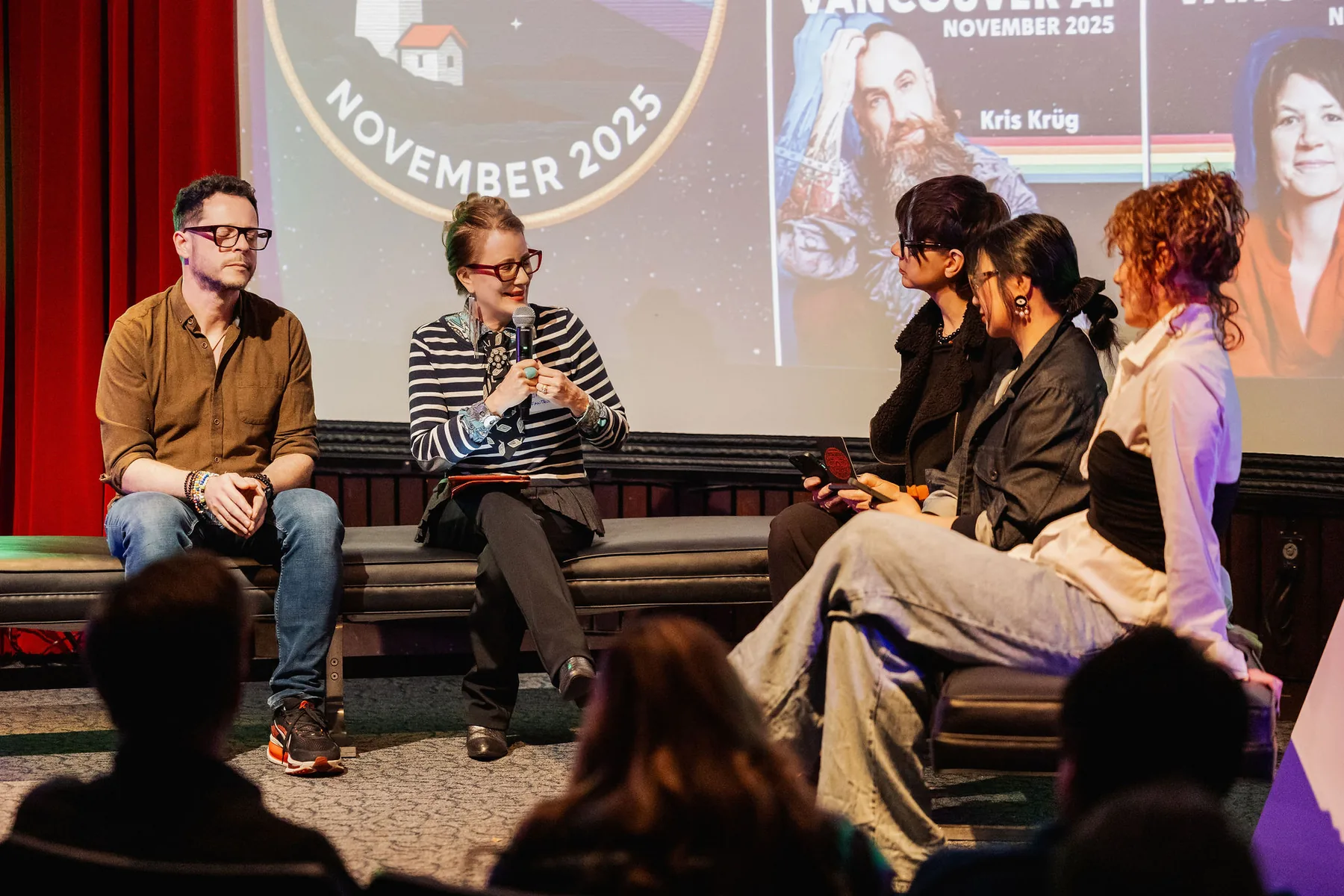
Editorial and rights note: All interview excerpts above are from Kris Krüg’s written response to THE INTELLIGENCE ENGINE, received October 16, 2026. Shortened where indicated by section selection, never AI-generated or attributed without the source reply. Kris also supplied an editorial-cleared community photo of a November 2025 BC + AI meetup, credited to Michelle Diamond; it is a link, not a claim that the photo was shot at the 2026 festival. Official speaker artworks and their terms are available in the Futureproof editorial press library.
SHOW ME! — WHEN CREATIVITY MEETS A MACHINE
HUMAN IDEA
WORKING PROTOTYPE
REAL FEEDBACK
IMPROVE
Photograph a familiar street
Sketch five images
Ask a neighbour what is missing
Re-shoot and re-edit
SHOW ME! · An original, text-and-table diagram for making with people and AI. No third-party image or implied model output.
THE SIMPLE BUILD LOOP: A human idea → a working prototype → a test with real people → a better version. The most interesting AI stories show every step, including the parts that did not work.
TRY THIS: A TINY VOICE-AI EXPERIMENT
Write down one question someone often asks in your work or hobbies. Sketch a three-turn conversation that helps them: ask what they need, offer a useful answer, and check whether it helped. It can be paper first, before any subscription, coding or automation. A useful AI product starts with a human need, not the fanciest model.
THE BUILDERS: A SUPPLIER INTELLIGENCE DESK
A retailer working with dozens of manufacturers must continually reconcile specification sheets, product photos, pricing, availability and rights to reuse marketing materials. An AI-assisted supplier desk could gather information, preserve source links, flag contradictions and prepare catalogue entries for approval.
The first experiment should be small: twenty products from a single category. Track the number of complete, source-verifiable records per human hour, and the number of errors not caught by the process. Do not mistake a public product listing for permission to distribute, copy imagery or quote a wholesale price.
THE BUSINESS OF AI: DEMONSTRATION VERSUS DELIVERY
A promising demo only becomes a business when customers repeatedly value the result, the cost is sustainable and quality survives changes in models and providers. Valuable differentiation may come from specialist knowledge, lawful access to reliable data, integrations and accountability.
THE COMMON-SENSE CORNER
AI agents carry operational risks: account access, privacy, insecure content, unauthorized actions and plausible but unsupported answers. Every issue of this magazine will distinguish original testing from vendor claims and published documentation.
THE CALENDAR
Futureproof Festival of AI — October 28–30, 2026, Vancouver's H.R. MacMillan Space Centre. A mix of makers, research, creative work and approachable human questions. Official program.
Web Summit — November 9–12, 2026, Lisbon. Technology, investment and startup programming.
The AI Summit New York — December 9–10, 2026, Javits Center. Enterprise AI and commercial adoption.
COMING NEXT ISSUE
Can a small business build an AI workforce? We'll examine model selection, permissions, tools, costs, audit logs and when to keep a human in control. We'll also publish real responses from our invited makers when they arrive and we have permission to quote them.
THE INTELLIGENCE ENGINE is an independent editorial publication and is not affiliated with OpenAI, Anthropic or Google. This issue does not claim independent product testing.
THE HUMAN-IN-CONTROL SYSTEM DIAGRAM · ORIGINAL HUNTER DESIGN STUDY
THE HUNTER VISION WORKSHOP
Our developing experiment in practical AI systems: useful data, clear logs, human approval, simple interfaces and real jobs worth automating. Not a shipping product. No hardware, inventory, performance figures or commercial availability claimed.
SEE THE THINKING, NOT JUST THE ANSWER. · ROOTED / HUNTER · ROOTEDCANADA.ORG
ADVERTISEMENT · ROOTED HOUSE AD · PROGRAM IDEA, NOT AN ENROLMENT OFFER
YOUR FIRST TOOL IS CURIOSITY.
A PLACE FOR THE KIDS WHO TAKE THINGS APART TO FIND OUT WHY THEY WORK.
[ 5 V ] ◯───◯───◯ POWER ↘ SENSOR ↗ ◁── MEASURE ── TEST ── BUILD ──▷
A WORKSHOP FIELD-NOTE / ORIGINAL DIAGRAM, NOT A PRODUCT PHOTO
ROOTED SKILLS · LEARN BY MAKING
Circuits, drawing, cameras, repair, fabrication, useful questions and the judgement to check your own work. A youth-access and mentoring vision in development, subject to partners, funding, safeguarding and qualified delivery. Nothing to buy or register for on this page.
ORIGINAL HUNTER TYPOGRAPHIC / TECHNICAL ILLUSTRATION · OCT 2026
An original HUNTER editorial concept for a small, transparent AI workflow bench: permissioned data, reproducible tests, visible change logs, and an explicit human who can stop the job. Research direction only; no physical kit, service, software, performance promise, sale or paid sponsorship.
INPUT
Documented, consented data
EVIDENCE
Source links and change records
SAFETY
Scoped permissions; approval gates
AVAILABILITY
Concept only — no product offered
THE WORK IS NOT DONE UNTIL THE RESULT HAS BEEN CHECKED. · HUNTER NETWORK
BACK COVER · OCTOBER 2026
THE INTELLIGENCE ENGINE
Be curious. Check the working. Build something useful.
One independent issue on the third Friday of each month.
HUNTER HOUSE AD labels apply to in-house promotions; outside manufacturer creative requires permission, verified specifications and clear attribution.